

Best Collagen Powder for Skin in 2026
Most collagen powders on the shelf look nearly identical. Same white powder, same vague skin claims, same fine print. But the differences in source, dose, and what's actually in the formula matter more than the marketing ever lets on. Here are our seven top picks for skin support right now, starting with the one we stand behind most.
1. AP Health Wellness Hub Grass-Fed Hydrolyzed Collagen Peptides , Our Top Pick for Everyday Skin Support
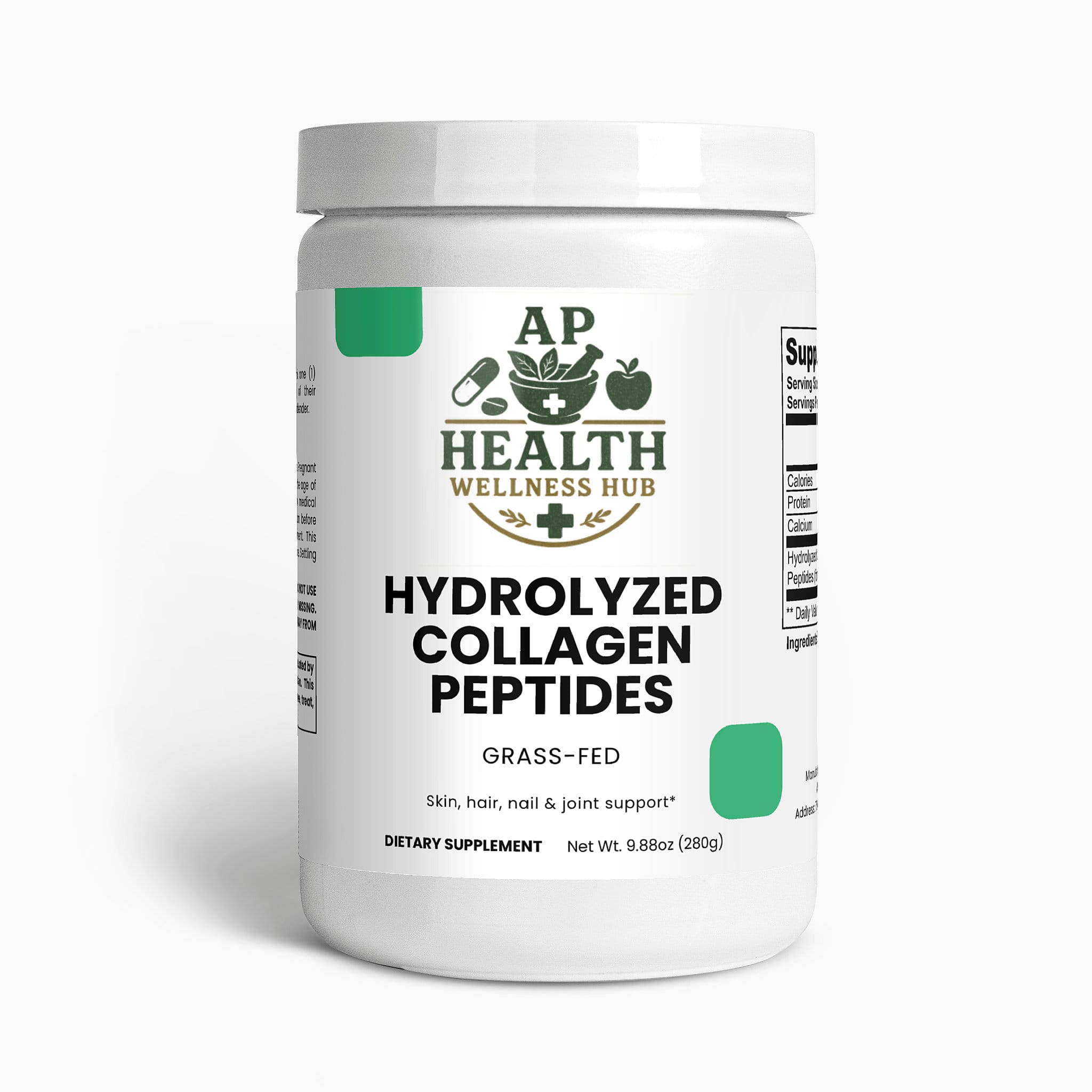
Our Grass-Fed Hydrolyzed Collagen Peptides at AP Health Wellness Hub is where we start every collagen conversation, and for good reason. It's a clean, straightforward formula built for people who want daily skin support without a complicated routine.
The collagen is hydrolyzed, which matters more than most labels explain. Hydrolysis breaks the collagen protein into smaller peptide chains. Those chains absorb through the gut and reach the bloodstream in a form the body can actually use. Research on bioactive collagen peptides has shown improvements in skin hydration, dermal density, and elasticity after consistent daily use over several weeks. Researchers have linked these results to the peptides' high hydroxyproline content and low molecular weight, both markers of quality hydrolysis.
Grass-fed sourcing also means the bovine hides come from cattle raised without the pesticide and antibiotic exposure that can show up as residues in lower-grade collagen. That's not just marketing language. Independent testing has flagged heavy metals in some popular collagen products, so sourcing transparency is a real differentiator, not a nice-to-have.
Who it's for: people who want a daily collagen habit that fits anywhere, whether that's morning coffee, a post-workout smoothie, or just water. The hydrolyzed format dissolves cleanly in both hot and cold liquids, so there's no clumping drama. It's also unflavored, which means it works in anything without changing the taste.
Consistency is what drives results with collagen. Most clinical studies see meaningful skin changes after 8 to 12 weeks of daily use. So this isn't a one-week experiment , it's a routine. At $63.90, it's a real investment. But cost-per-dose math works in its favor compared to smaller containers that run out in two weeks.
One honest caveat: the product page doesn't currently publish a certificate of analysis. If heavy-metal testing transparency is a top priority for you, ask us directly. We believe in usable wellness, and that includes being straight about what we know and what we're working on.
2. AP Health Wellness Hub Grass-Fed Collagen Creamer (Vanilla) , Best Collagen Powder for Morning Routines
If you already drink coffee every morning, this is the easiest collagen upgrade you can make. Our Grass-Fed Collagen Creamer in Vanilla at AP Health Wellness Hub adds collagen peptides directly into your cup, so you're not adding another step to your day.
The vanilla flavor does real work here. Plain collagen powder has a faint, almost brothy taste that some people notice and some don't. A good collagen creamer solves that entirely. You get the collagen benefit without adjusting to any off-note, and the vanilla makes it feel like a treat instead of a supplement.
Priced at $35.90, it's also the most approachable entry point in our collagen line. For someone new to collagen who isn't sure they'll stick with it, starting with the creamer makes usable sense. You're already making coffee. You're already reaching for something to put in it. This just makes that moment count for your skin too.
The format matters for habit-building. Research on supplement adherence consistently shows that people stick with products that fit their existing routines. Adding a scoop to hot coffee (pour the coffee over the powder, not the other way around , it mixes smoother that way) takes about five seconds. That's a routine you'll actually keep.
Worth knowing: collagen creamers combine collagen peptides with other ingredients that give them their creamy texture and flavor. The collagen per serving is typically lower than a pure peptide powder, so if you're targeting the higher daily doses used in clinical research (10 g or more), you may want to pair it with the plain peptide powder or use the creamer as a complement rather than your only source.
It also works in oatmeal or matcha, not just coffee. That flexibility makes it easier to use on days when you skip the morning brew.
3. Vital Proteins Collagen Peptides , Best-Known Bovine Option with Added Hyaluronic Acid
Vital Proteins is probably the name you've already heard. It's one of the most recognized collagen brands in the US, and the peptides formula has a long track record with a large base of users. The formula delivers 20 g of collagen per serving, sourced from grass-fed bovine hide, providing Types I and III , the types most associated with skin structure and elasticity.
What sets it apart from most pure peptide powders is the addition of hyaluronic acid and vitamin C. Vitamin C is a necessary co-factor for collagen synthesis in the body , without enough of it, your cells can't build new collagen even if they have all the amino acids they need. Hyaluronic acid supports skin hydration by holding water in the dermis. Combining these in one serving targets multiple sides of the skin-aging equation at once.
Mixability is one of its genuine strengths. In side-by-side testing, Vital Proteins consistently dissolves well in both hot and cold liquids, with a smooth texture and a mild taste that some testers describe as faintly broth-like. It's not offensive, and it disappears entirely in a flavored drink.
The packaging was updated to use 90% less plastic, with at least 80% paperboard from FSC-certified sustainable forests. That's a meaningful change for a product this widely used.
The caveat: it carries NSF Sport certification, but explicit heavy-metal testing results aren't published at the lot level. Pricing varies by retailer and pack size, so daily users should compare options before committing. The 9.33 oz tub gives you only around 14 servings, so daily users reorder often. It earns its place on this list, but the cost adds up faster than many people expect.
4. Sports Research Marine Collagen , Best for Those Who Prefer Pescatarian-Friendly Sources
Marine collagen is the go-to choice for people who avoid land animals but still want the skin benefits of a collagen supplement. Sports Research sources theirs from wild-caught barramundi and red snapper, both Non-GMO tested through the IGEN certification program.
Each serving delivers 10 g of hydrolyzed marine collagen peptides , a dose that lands squarely in the range used in clinical studies on skin elasticity. The marine source provides Types I and III collagen, the same types associated with dermal structure. Marine collagen peptides also tend to have a lower molecular weight than bovine-derived peptides, which some researchers believe improves bioavailability, though the evidence comparing the two sources directly is still developing.
The single-ingredient formula keeps things clean. It's keto certified and pescatarian-friendly, which matters for a real segment of buyers who've struggled to find a collagen that fits their dietary approach. The powder mixes into water or juice and works in any beverage without adding flavor.
One thing worth knowing about marine collagen broadly: fish-sourced collagen can carry microplastic contamination from ocean waters if sourcing isn't tightly controlled. Wild-caught sourcing from specific named species (as Sports Research discloses) is a better sign than vague "marine collagen" labels with no origin details. Still, unlike bovine collagen with explicit third-party heavy-metal testing, marine collagen products require buyers to do a bit more homework on contamination screening.
Pricing varies by retailer, but Sports Research has Informed Choice certification, which is worth something for competitive athletes who need banned-substance assurance. For general skin support, it's a solid option if pescatarian sourcing is a priority for you.
If joint support alongside skin benefits is also on your radar, note that marine collagen typically provides Types I and III but not Type II, which targets cartilage specifically.
5. Ancient Nutrition Chocolate Collagen Peptides , Best Multi-Source Collagen for Broad Skin and Joint Coverage

Ancient Nutrition takes a different approach than most collagen powders on this list. Instead of a single bovine or marine source, this formula pulls from beef, chicken, fish, and fermented eggshell membrane. The result is a blend that covers Types I, II, and III collagen in one serving.
For skin, Types I and III are the ones doing the main work. But the addition of Type II (from chicken) means this powder also addresses cartilage, which makes it a reasonable pick for anyone dealing with joint discomfort alongside skin aging. That said, if you're buying purely for skin support, the multi-source complexity adds cost and may include collagen types you don't specifically need.
The chocolate flavor genuinely helps. Unflavored collagen in a smoothie is easy enough, but a chocolate-flavored powder opens up a wider range of daily uses , mixed into cold brew, blended with nut milk, or stirred into oatmeal. The taste has improved through formula updates, and recent testers rate it a clean 8/10 on flavor.
Ancient Nutrition also adds vitamin C and soil-based probiotics. Vitamin C supports collagen synthesis at the cellular level, and the probiotic addition targets gut health as a secondary benefit. Some evidence suggests gut lining integrity affects how well collagen peptides are absorbed, so the pairing isn't arbitrary , though the specific strains and their effects on collagen absorption haven't been studied directly in this formula.
Sourcing is pasture-raised for the bovine component, which is a positive transparency signal. The formula is also non-GMO. If you're avoiding chicken or fish for dietary reasons, this one isn't for you , the multi-source design means it touches several animal categories.
If you want skin support paired with a broader nutritional profile and you don't have dietary restrictions on the source animals, this is worth considering. It's not the cleanest single-ingredient option, but it's one of the more complete multi-source formulas available right now. Pairing it with our Hair, Skin and Nails Essentials can round out a fuller skin and hair support routine.
6. Nature Made Collagen Peptides Powder, Best Budget-Friendly Option with Third-Party Verification
Nature Made is one of the most widely recognized supplement brands in the US, and their Collagen Peptides Powder brings something genuinely useful to the budget end of this category: an 11 g serving of Types I and III collagen, with biotin added for hair and nail support.
Biotin is a B vitamin that plays a role in keratin production. Adding it to a collagen powder makes sense from a hair and nail standpoint, since both collagen amino acids and biotin contribute to the structural proteins in hair and nails. It's a usable pairing for anyone whose main goals include skin, hair, and nails together.
Nature Made products carry USP verification, which is a meaningful third-party credential. USP (the US Pharmacopeia) tests that a product contains what the label claims, in the amounts stated, without harmful contaminants. For budget-conscious buyers who can't afford to guess on quality, a USP mark reduces some of that risk.
The collagen dose at 11 g sits slightly below the 20 g serving in some premium options, but it's within the range used in positive clinical studies. Research on hydrolyzed collagen peptides has found skin benefits at doses in the 5–10 g daily range, and many study protocols use doses across that range with consistent results. The 11 g serving covers that range comfortably.
The honest limitation: Nature Made doesn't disclose country-of-origin for the bovine source or publish lot-level certificates of analysis. USP verification covers contaminant testing, but it's less detailed than an NSF certification with explicit heavy-metal screening. For everyday users not at improved risk from contaminants, it's a reasonable tradeoff at the price point. Just know what you're getting and what you're not.
7. ELASTEN® , Best Clinically Studied Low-Dose Option
ELASTEN® is the product behind one of the more rigorous collagen studies we found during our research. A randomized, placebo-controlled trial tested ELASTEN® on women over 12 weeks. At just 2.5 g of collagen peptides per serving, the product produced statistically significant improvements in skin hydration, elasticity, roughness, and density , and those improvements held through a four-week follow-up period after participants stopped taking it.
That low-dose result is worth pausing on. Most collagen powders push 10 g to 20 g per serving. ELASTEN®'s formula uses only 2.5 g, combined with acerola fruit extract, vitamin C, zinc, and a native vitamin E complex. The researchers described the peptide complex as having "high coverage" , meaning the amino acid sequences closely match those found in human skin collagen. That specificity, not just the volume, may explain why the results showed up at such a low dose.
ELASTEN® comes in drinking ampoules rather than a powder you mix yourself. That's a different format from everything else on this list, and some people find it more convenient while others prefer the flexibility of a powder. The ampoule format also removes any concerns about clumping or solubility.
One clear limitation: ELASTEN® is not as widely available in the US as the other options here, and it's not positioned as a budget product. The combination of clinical backing and specialty positioning puts it in a specific niche. If you want the most direct clinical evidence trail for a skin-focused collagen product, it's the strongest case study on this list. But it may require more effort to source than popping a container of peptide powder into your cart.
Body care that addresses skin from multiple angles tends to work better over time. If you're already using a collagen supplement and want to support skin from the outside as well, an anti-aging moisturizer used daily alongside your collagen routine gives you both internal and topical support working together.
How to Choose the Best Collagen Powder for Skin , Buyer's Checklist
Walking into this category without a framework is how you end up paying $50 for a product with dosing information listed in micrograms instead of grams. That unit confusion is common, and it matters: most clinical studies use doses of 2.5 g to 10 g daily. A product listing doses in micrograms is 1,000 times lower than that range. Always check the unit on the label.
Here's what to look at before buying:
Source matters, but not in the way marketing usually frames it. The amino acid profiles of bovine and marine collagen are similar. The real difference is tolerance and dietary preference. People avoiding red meat often do better with marine collagen. People sensitive to fish should stick to bovine. Neither is inherently superior for skin , what matters more is the quality of hydrolysis and the purity of the peptides.
Timeline is something buyers consistently underestimate. Most people expect results in a week or two. The clinical evidence says 8 weeks at minimum, with more pronounced effects at 12 weeks. Consistency over time matters far more than the specific brand you pick. That's a recurring theme across dermatologists and researchers who study this category: a decent product you take daily beats a great product you take sporadically.
One usable consideration that rarely shows up on labels: if you're also managing issues like posture-related neck tension or back discomfort , common in people who spend long hours at desks , connective tissue supplements like collagen may support tissue repair, but they work alongside physical care, not instead of it. For people looking at complete body support, combining collagen with movement-based approaches addresses both internal and structural factors.
Finally, look at cost per 10 g of collagen, not cost per container. A big jar at $30 might sound like a deal, but if each serving only gives you 5 g, you're effectively paying more per clinically relevant dose than a smaller jar at $45 with 20 g per serving. Do the math before you buy.
FAQ
How long does collagen powder take to work for skin?
Most people see measurable improvements in skin hydration and elasticity after 8 to 12 weeks of daily use. Some studies show changes as early as 8 weeks, but 12 weeks is the point where results become more consistent across different trials. You won't see much in the first two weeks, so don't stop early. Daily consistency matters more than the specific dose you choose within the effective range.
What's the difference between bovine and marine collagen for skin?
Both bovine and marine collagen provide Types I and III, which are the types most relevant for skin elasticity and hydration. Marine collagen peptides tend to have a lower molecular weight, which may improve absorption slightly, though direct comparisons between sources in clinical trials are limited. The bigger usable difference is sourcing transparency and dietary fit , marine suits pescatarians, bovine suits those avoiding fish.
How much collagen powder should I take per day for skin?
Clinical studies showing positive skin results typically use between 2.5 g and 10 g of hydrolyzed collagen peptides per day. There's no strong evidence that 20 g daily outperforms 5 g, so higher doses aren't necessarily better. A dose in the 5, 10 g range, taken consistently every day, covers what the research supports for skin hydration and elasticity improvements.
Can I mix collagen powder into coffee?
Yes. Hydrolyzed collagen peptides dissolve in both hot and cold liquids. Hot coffee works particularly well , pour the coffee over the powder and stir. Avoid adding the powder to already-poured coffee if you want a lump-free result. Collagen doesn't significantly change the taste of black coffee, though unflavored versions may have a faint, mild note that disappears in flavored drinks.
Is collagen powder safe, and are there side effects?
Collagen peptide supplements are generally well tolerated in studies. The most common concern is contamination , some popular collagen products have tested positive for heavy metals like lead and cadmium, which concentrate in animal bones and connective tissue. Choosing products with third-party testing (NSF, USP, or published certificates of analysis) reduces that risk. People with fish or shellfish allergies should avoid marine collagen and check labels carefully on any blend.
Does it matter if collagen powder is grass-fed?
Grass-fed sourcing reduces the likelihood of pesticide and antibiotic residues compared to conventionally raised cattle. It's a sourcing transparency signal, not a guarantee of purity on its own , a grass-fed product without third-party testing still carries uncertainty. Ideally you want both: a verified grass-fed source and independent contamination testing. When only one credential is available, third-party testing is the more protective of the two.
Conclusion
If you're starting a collagen routine for skin support, our Grass-Fed Hydrolyzed Collagen Peptides at AP Health Wellness Hub is the straightforward daily option we'd point you toward first. If mornings are easier with a flavored creamer, our Vanilla Collagen Creamer gets you in the habit without changing anything about how you already start your day. Browse our full skin and beauty supplement range at AP Health Wellness Hub's health and beauty collection to find the format that fits your life , then give it 8 to 12 weeks of consistency before you judge the results.